
Digital Scanners vs. Goop: Why Technology Should Be on Your Checklist
There is a specific kind of dread that hits when a dental tray full of cold, sticky material gets pressed into your mouth. The taste. The pressure. The overwhelming urge to gag. It is an experience that stays with patients long after the appointment ends, and for a lot of people, it is reason enough to keep putting off the dentist.
No trays. No putty. No gag reflex. Just a small wand, a few minutes, and a precise digital scan that captures everything the dentist needs.
At Pinnacle Dental Group, we hear about impression dread regularly from patients of all ages. It is one of the reasons we invested in digital scanning technology. This article walks you through how digital scanning works, why it is better than the traditional method, and why the technology a dental practice chooses to invest in is itself worth paying attention to when you are picking a dentist in Monroe.
What Are Traditional Impressions and Why Do Patients Dread Them?
For decades, dental impressions were made the same way. A tray loaded with soft, clay-like material was pressed firmly against the upper and lower teeth and held in place until it hardened. For routine patients in routine conditions, the process worked well enough. But for a significant number of people, it was genuinely unpleasant.
The most common complaints were triggering the gag reflex, an unpleasant taste, uncomfortable pressure against the soft tissues of the mouth, and the anxiety of feeling like the material might not come out in time. For children, this experience can make subsequent dental visits feel more threatening than they need to be. For seniors with sensitive tissues or a stronger gag reflex, it could be difficult to tolerate at all.
Beyond patient comfort, traditional impressions had practical problems too. Physical molds could be damaged during shipping to dental labs. The material could shift slightly before fully setting. Errors sometimes required the whole process to start over, which meant more time in the chair and more frustration for everyone.
What Is a Digital Dental Scanner?
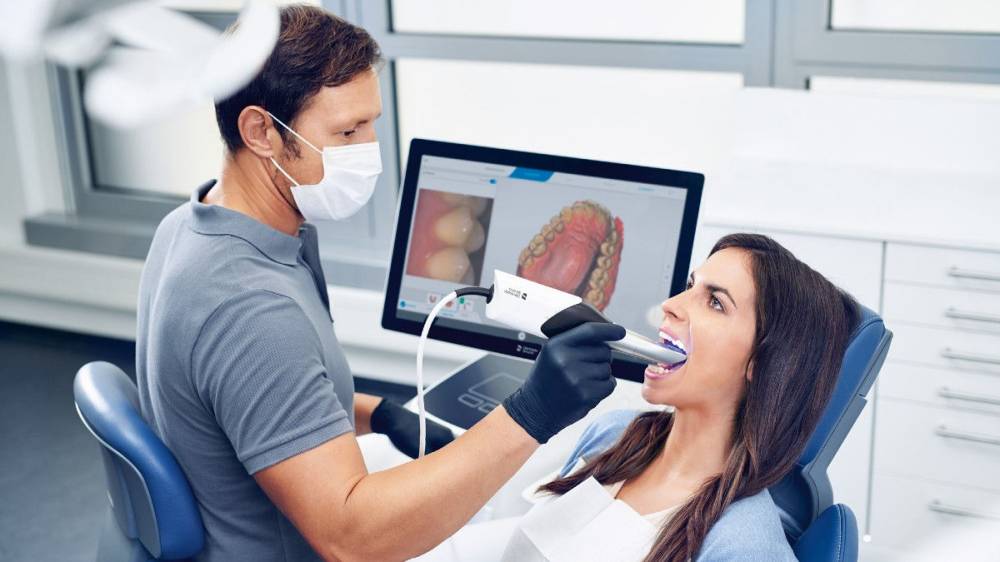
A digital dental scanner is a small handheld wand that uses structured light technology to capture a detailed, three-dimensional image of your teeth and gums. The wand moves slowly and gently around the inside of the mouth, and as it moves, a precise digital model builds in real time on a screen next to the chair. No material touches the inside of your mouth. No trays. No waiting for anything to set.
The scan typically takes just a few minutes for most patients. Many find it reassuring to watch the model take shape on the screen while it happens. That visibility tends to reduce anxiety and gives patients a clearer picture of what is actually going on in their mouth.
When the scan is complete, the digital file is sent directly to our dental lab as a precise electronic file. This removes the risk of mold damage in transit, cuts down processing time, and gives the lab exactly what they need to produce a well-fitting result from the first attempt.
Digital Scanners vs. Traditional Impressions: How They Compare
Here is a direct look at how the two methods stack up across the categories that matter most to patients:
- Comfort: Traditional impressions involve goopy material and a real risk of triggering the gag reflex. Digital scanning uses only a small wand with no material placed in the mouth.
- Chair time: Traditional impressions require several minutes of waiting for material to set. Digital scans capture images in real time with no waiting.
- Accuracy: Physical molds can distort slightly before they fully harden. Digital models are highly precise and consistent.
- Re-dos: Errors in traditional impressions often require the whole process to be repeated. Digital scans rarely need to be redone.
- Storage and transfer: Physical molds must be stored carefully and shipped to the lab. Digital files are stored electronically and transmitted instantly.
- Patient anxiety: Traditional impressions consistently rank among the most uncomfortable parts of a dental visit. Digital scanning removes that friction almost entirely.
Fewer errors also mean fewer adjustment appointments. For patients managing busy schedules, that difference is real. One well-fitting restoration placed on the first try beats two trips back to the office every time.
Which Procedures Benefit Most From Digital Scanning?
Digital scanning is not limited to one type of treatment. It has become a valuable part of a wide range of procedures, including many of the most commonly requested services at our Monroe office:
- Crowns and bridges: Precise digital models help ensure a well-fitting restoration from the first placement, reducing the need for multiple adjustment visits. Crowns require an exact fit to function and feel right, and digital impressions consistently deliver that.
- Invisalign treatment planning: Digital scans map the exact position of each tooth and allow us to model projected tooth movement throughout the full course of treatment.
- Dental implants: Accurate imaging is critical for proper implant placement, and digital scans provide the precision that this procedure demands.
- Veneers: A precise fit is essential for veneers to look natural and function correctly. Digital impressions deliver that level of accuracy consistently.
- Dentures and partial dentures: Patients who may struggle with traditional impressions benefit especially from the gentler digital scanning process.
For families bringing children in for orthodontic evaluations, digital scanning removes one of the most anxiety-provoking steps. Children who might otherwise resist or become distressed during traditional impressions typically tolerate the digital wand without issue, which makes the whole appointment easier for the child, the parent, and our team.
What a Practice’s Technology Tells You About Their Priorities
Advanced technology is a key indicator when selecting a top-tier dentist in Monroe. Not because new equipment is inherently impressive, but because investing in it costs real money, requires staff training, and signals a deliberate choice about how a practice wants to treat its patients.
A dental office still relying on traditional impression trays is not necessarily providing poor care, but it is worth asking why. The materials cost less. The process is familiar. Changing it requires effort. A practice that makes that change anyway is telling you something about where patient experience sits in their priorities.
At Pinnacle Dental Group, our technology investments reflect that same thinking. In addition to digital scanning, our office uses Cone Beam 3D Imaging for detailed views of bone structure, nerve placement, and sinus health that standard X-rays cannot provide. We use digital X-rays, which reduce radiation exposure and transmit images directly to the chair. Our intraoral camera captures high-definition images that let patients see exactly what the dentist sees. And for patients with gum disease, we offer LANAP laser treatment, an FDA-cleared laser procedure that treats gum disease without scalpels or sutures.
Each of those technologies exists because we decided the patient experience and clinical outcome were worth the investment. That is the standard we think every dental practice should be held to, and it is the standard we apply to ourselves.
Why This Matters for Monroe Families
Monroe families lead full lives. Work schedules, school pickups, after-school activities, and everything else that fills a week leave little margin for extra trips back to the dentist because a restoration did not fit correctly the first time. Digital scanning helps prevent exactly that scenario.
For parents coordinating appointments for multiple children, the ability to complete accurate scans quickly, without the risk of a child gagging and needing the process repeated, is a genuine relief. Our investment in this technology is one of the ways we try to make dental care feel manageable rather than burdensome for families who are already juggling a lot.
For our senior patients, the benefits are equally real. Age-related changes to oral tissues can make traditional impressions uncomfortable in ways that go beyond simple inconvenience. Digital scanning removes that concern entirely, offering a gentler experience that respects the specific needs of older adults, whether they are exploring implant options, being fitted for dentures, or coming in for a routine exam.
Is Digital Scanning Accurate Enough to Trust?
This is a question we welcome, because it reflects the kind of thinking that good healthcare decisions require. The short answer is yes. Digital dental impressions have been widely adopted across the profession precisely because of the accuracy.
Digital scans produce a level of dimensional precision that is difficult to match with traditional physical impressions. Because the model is captured electronically and transmitted directly to the lab, there is no opportunity for the kind of distortion that can happen when physical molds are removed from the mouth, transported, and handled during the fabrication process. The result is a restoration or appliance that fits correctly the first time, with fewer adjustments needed after placement.
At Pinnacle Dental Group, we do not adopt new tools just because they are available. We invest in technology when we are confident it will genuinely improve outcomes and experiences for our patients. Digital scanning met that standard, which is why it is now a standard part of our process.
What to Expect at Your Digital Scan Appointment
If you have never had a digital scan before, here is what the experience looks like at our Monroe office:
- A small handheld wand is moved carefully and gently along the surfaces of your teeth and gums.
- As the wand moves, a detailed three-dimensional model builds in real time on a screen you can see from the chair.
- No material is placed in your mouth. No trays. No waiting for anything to set or harden.
- The scan is typically complete within a few minutes, depending on the scope of the procedure being planned.
- Once the scan is complete, the digital file is sent directly to our dental lab for fabrication.
There is no aftertaste, no cleanup, and no residual discomfort when you leave. Patients who have experienced both methods overwhelmingly prefer the digital process.
Ready to See What Modern Dentistry Feels Like?
If you have been putting off a dental procedure because you were dreading the impression process, that barrier is gone. For families and individuals looking for modern dentistry Monroe residents can actually rely on, we are ready to show you what that looks like in practice.
Call us at 734-241-6166 to schedule your appointment. Pinnacle Dental Group is at 1262 North Macomb Street, Monroe, MI 48162, open Monday through Friday, 8 AM to 5 PM. Saturday appointments are available by request.